Tag: Quick Sort

  • Randomized Selection Algorithm (Quickselect) – Python Code

    Randomized Selection Algorithm (Quickselect) – Python Code

    Find the kth smallest element in an array without sorting.

    That’s basically what this algorithm does. It piggybacks on the partition subroutine from the Quick Sort. If you don’t know what that is, you can check out more about the Quick Sort algorithm here and here, and understand the usefulness of partitioning an unsorted array around a pivot.

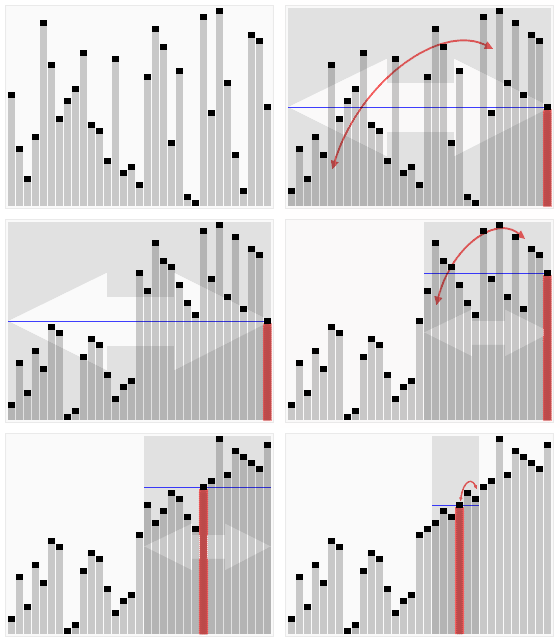
    Selecting_quickselect_frames
    Animated visualization of the randomized selection algorithm selecting the 22nd
    smallest value

    Python Implementation

    from random import randrange
    def partition(x, pivot_index = 0):
    i = 0
    if pivot_index !=0: x[0],x[pivot_index] = x[pivot_index],x[0]
    for j in range(len(x)-1):
    if x[j+1] < x[0]:
    x[j+1],x[i+1] = x[i+1],x[j+1]
    i += 1
    x[0],x[i] = x[i],x[0]
    return x,i
    def RSelect(x,k):
    if len(x) == 1:
    return x[0]
    else:
    xpart = partition(x,randrange(len(x)))
    x = xpart[0] # partitioned array
    j = xpart[1] # pivot index
    if j == k:
    return x[j]
    elif j > k:
    return RSelect(x[:j],k)
    else:
    k = k – j – 1
    return RSelect(x[(j+1):], k)
    x = [3,1,8,4,7,9]
    for i in range(len(x)):
    print RSelect(x,i),
    view raw RSelect.py hosted with ❤ by GitHub


    Related Posts
    Quick Sort Python Code
    Computing Work Done (Total Pivot Comparisons) by Quick Sort

  • Computing Work Done (Total Pivot Comparisons) by Quick Sort

    A key aspect of the Quick Sort algorithm is how the pivot element is chosen. In my earlier post on the Python code for Quick Sort, my implementation takes the first element of the unsorted array as the pivot element.

    However with some mathematical analysis it can be seen that such an implementation is O(n2) in complexity while if a pivot is randomly chosen, the Quick Sort algorithm is O(nlog2n).

    To witness this in action, one can measure the work done by the algorithm comparing two cases, one with a randomized pivot choice – and one with a fixed pivot choice, say the first element of the array (or the last element of the array).

    Implementation

    A decent proxy for the amount of work done by the algorithm would be the number of pivot comparisons. These comparisons needn’t be computed one-by-one, rather when there is a recursive call on a subarray of length m, you should simply add m−1 to your running total of comparisons.

    3 Cases

    To put things in perspective, let’s look at 3 cases. (This is basically straight out of a homework assignment from Tim Roughgarden’s course on the Design and Analysis of Algorithms).
    Case I with the pivot being the first element.
    Case II with the pivot being the last element.
    Case III using the “median-of-three” pivot rule. The primary motivation behind this rule is to do a little bit of extra work to get much better performance on input arrays that are nearly sorted or reverse sorted.

    Median-of-Three Pivot Rule

    Consider the first, middle, and final elements of the given array. (If the array has odd length it should be clear what the “middle” element is; for an array with even length 2k, use the kth element as the “middle” element. So for the array 4 5 6 7, the “middle” element is the second one —- 5 and not 6! Identify which of these three elements is the median (i.e., the one whose value is in between the other two), and use this as your pivot.

    Python Code

    This file contains all of the integers between 1 and 10,000 (inclusive, with no repeats) in unsorted order. The integer in the ith row of the file gives you the ith entry of an input array. I downloaded this file and named it QuickSort_List.txt

    You can run the code below and see for yourself that the number of comparisons for Case III are 138,382 compared to 162,085 and 164,123 for Case I and Case II respectively. You can play around with the code in an IPython / Jupyter notebook here.

    #!/usr/bin/env
    # Case I
    # First element of the unsorted array is chosen as pivot element for sorting using Quick Sort
    def countComparisonsWithFirst(x):
    """ Counts number of comparisons while using Quick Sort with first element of unsorted array as pivot """
    global count_pivot_first
    if len(x) == 1 or len(x) == 0:
    return x
    else:
    count_pivot_first += len(x)-1
    i = 0
    for j in range(len(x)-1):
    if x[j+1] < x[0]:
    x[j+1],x[i+1] = x[i+1], x[j+1]
    i += 1
    x[0],x[i] = x[i],x[0]
    first_part = countComparisonsWithFirst(x[:i])
    second_part = countComparisonsWithFirst(x[i+1:])
    first_part.append(x[i])
    return first_part + second_part
    # Case II
    # Last element of the unsorted array is chosen as pivot element for sorting using Quick Sort
    def countComparisonsWithLast(x):
    """ Counts number of comparisons while using Quick Sort with last element of unsorted array as pivot """
    global count_pivot_last
    if len(x) == 1 or len(x) == 0:
    return x
    else:
    count_pivot_last += len(x)-1
    x[0],x[-1] = x[-1],x[0]
    i = 0
    for j in range(len(x)-1):
    if x[j+1] < x[0]:
    x[j+1],x[i+1] = x[i+1], x[j+1]
    i += 1
    x[0],x[i] = x[i],x[0]
    first_part = countComparisonsWithLast(x[:i])
    second_part = countComparisonsWithLast(x[i+1:])
    first_part.append(x[i])
    return first_part + second_part
    # Case III
    # Median-of-three method used to choose pivot element for sorting using Quick Sort
    def middle_index(x):
    """ Returns the index of the middle element of an array """
    if len(x) % 2 == 0:
    middle_index = len(x)/2 – 1
    else:
    middle_index = len(x)/2
    return middle_index
    def median_index(x,i,j,k):
    """ Returns the median index of three when passed an array and indices of any 3 elements of that array """
    if (x[i]-x[j])*(x[i]-x[k]) < 0:
    return i
    elif (x[j]-x[i])*(x[j]-x[k]) < 0:
    return j
    else:
    return k
    def countComparisonsMedianOfThree(x):
    """ Counts number of comparisons while using Quick Sort with median-of-three element is chosen as pivot """
    global count_pivot_median
    if len(x) == 1 or len(x) == 0:
    return x
    else:
    count_pivot_median += len(x)-1
    k = median_index(x, 0, middle_index(x), -1)
    if k != 0: x[0], x[k] = x[k], x[0]
    i = 0
    for j in range(len(x)-1):
    if x[j+1] < x[0]:
    x[j+1],x[i+1] = x[i+1], x[j+1]
    i += 1
    x[0],x[i] = x[i],x[0]
    first_part = countComparisonsMedianOfThree(x[:i])
    second_part = countComparisonsMedianOfThree(x[i+1:])
    first_part.append(x[i])
    return first_part + second_part
    #####################################################################
    # initializing counts
    count_pivot_first = 0; count_pivot_last = 0; count_pivot_median = 0
    #####################################################################
    # Cast I
    # Read the contents of the file into a Python list
    NUMLIST_FILENAME = "QuickSort_List.txt"
    inFile = open(NUMLIST_FILENAME, 'r')
    with inFile as f: numList = [int(integers.strip()) for integers in f.readlines()]
    # call functions to count comparisons
    countComparisonsWithFirst(numList)
    #####################################################################
    # Read the contents of the file into a Python list
    NUMLIST_FILENAME = "QuickSort_List.txt"
    inFile = open(NUMLIST_FILENAME, 'r')
    with inFile as f: numList = [int(integers.strip()) for integers in f.readlines()]
    # call functions to count comparisons
    countComparisonsWithLast(numList)
    #####################################################################
    # Read the contents of the file into a Python list
    NUMLIST_FILENAME = "QuickSort_List.txt"
    inFile = open(NUMLIST_FILENAME, 'r')
    with inFile as f: numList = [int(integers.strip()) for integers in f.readlines()]
    # call functions to count comparisons
    countComparisonsMedianOfThree(numList)
    #####################################################################
    print count_pivot_first, count_pivot_last, count_pivot_median
  • Quick Sort Python Code

    Quick Sort Python Code

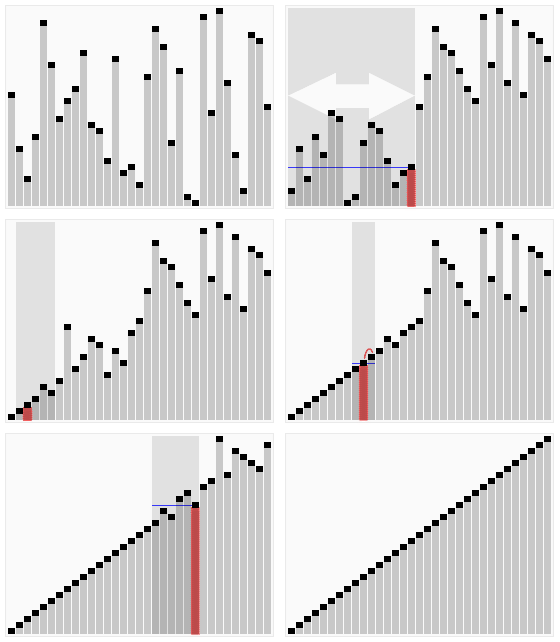
    Sorting_quicksort_anim

    Yet another post for the crawlers to better index my site for algorithms and as a repository for Python code. The quick sort algorithm is well explained in the topmost Google search result for ‘Quick Sort Python Code’, but the code is unnecessarily convoluted. Instead, go with the code below.

    In it, I assume the pivot to be the first element. You can easily add a function to  randomize selection of the pivot. Choosing a random pivot minimizes the chance that you will encounter worst-case O(n2) performance. Always choosing first or last would cause worst-case performance for nearly-sorted or nearly-reverse-sorted data.

    def quicksort(x):
    if len(x) == 1 or len(x) == 0:
    return x
    else:
    pivot = x[0]
    i = 0
    for j in range(len(x)-1):
    if x[j+1] < pivot:
    x[j+1],x[i+1] = x[i+1], x[j+1]
    i += 1
    x[0],x[i] = x[i],x[0]
    first_part = quicksort(x[:i])
    second_part = quicksort(x[i+1:])
    first_part.append(x[i])
    return first_part + second_part
    alist = [54,26,93,17,77,31,44,55,20]
    quicksort(alist)
    print(alist)
    view raw quicksort.py hosted with ❤ by GitHub

    Also read:
    Computing Work Done (Total Pivot Comparisons) by Quick Sort
    Karatsuba Multiplication Algorithm – Python Code
    Merge Sort