MOOC Review: Introduction to Computer Science and Programming Using Python (6.00.1x)

I enrolled in Introduction to Computer Science and Programming Using Python with the primary objective of learning to code using Python. This course, as the name suggests, is more than just about Python. It uses Python as a tool to teach computational thinking and serves as an introduction to computer science. The fact that it is a course offered by MIT, makes it special.

As a matter of fact, this course is aimed at students with little or no prior programming experience who feel the need to understand computational approaches to problem solving. Eric Grimson is an excellent teacher (also Chancellor of MIT) and he delves into the subject matter to a surprising amount of detail.

The video lectures are based on select chapters from an excellent book by John Guttag. While the book isn’t mandatory for the course (the video lectures do a great job of explaining the material on their own), I benefited greatly from reading the textbook. There are a couple of instances where the code isn’t presented properly in the slides (typos or indentation gone wrong when pasting code to the slides), but the correct code / study material can be found in the textbook. Also, for explanations that are more in-depth, the book comes in handy.

Introduction to Computation and Programming Using Python

MIT offers this course in 2 parts via edX. While 6.00.1x is is an introduction to computer science as a tool to solve real-world analytical problems, 6.00.2x is an introduction to computation in data science. For a general look and feel of the course, this OCW link may be a good starting point. It contains material including video lectures and problem sets that are closely related to 6.00.1x and 6.00.2x.

Each week’s material of 6.00.1x consists of 2 topics, followed by a Problem Set. Problem Sets account for 40% of your grade. Video lectures are followed by finger exercises that can be attempted any number of times. Finger exercises account for 10% of your grade. The Quiz (kind of like a mid-term exam) and the Final Exam account for 25% each. The course is of 8 weeks duration and covers the following topics (along with corresponding readings from John Guttag’s textbook).

course_structure_till_quiz

course_structure_till_final

From the questions posted on forums, it was apparent that the section of this course that most people found challenging, was efficiency and orders of growth – and in particular, the Big-O asymptotic notation and problems on algorithmic complexity.

Lectures on Classes, Inheritance and Object Oriented Programming (OOP) were covered really well in over 100 minutes of video time. I enjoyed the problem set that followed, requiring the student to build an Internet news filter alerting the user when it noticed a news story that matched that user’s interests.

The final week had lectures on the concept of Trees, which were done hurriedly when compared to the depth of detail the instructor had earlier gone to, while explaining concepts from previous weeks. However, this material was covered quite well in Guttag’s textbook and the code for tree search algorithms was provided for perusal as part of the courseware.

At the end of the course, there were some interesting add-on videos to tickle the curiosity of the learner on the applications of computation in diverse fields such as medicine, robotics, databases and 3D graphics.

The Wiki tab for this course (in the edX platform) is laden with useful links to complement each week of lectures. I never got around to reading those, but I’m going through them now, and they’re quite interesting. It’s a section that nerds would love to skim through.

I learnt a great deal from this course (scored well too) putting in close to 6-hours-a-week of study. It is being offered again on August 26, 2015. In the mean time, I’m keeping my eyes open for MIT’s data science course (6.00.2x) which is likely to be offered in October, in continuation to 6.00.1x.
Which Programming Languages Get Used Most At Hackathons?

For a quick peek into the list:

The Top 10 Languages At Devpost’s Hackathons:

  1. HTML/CSS (see note below)
  2. JavaScript
  3. Python
  4. Java
  5. C/C++
  6. PHP
  7. Objective-C
  8. C#
  9. Swift
  10. JSON (which isn’t … really a programming language, but is on their list for some reason, so I’m including #11 too)
  11. Ruby

Read the full Techcrunch article to know why.

In stark contrast:

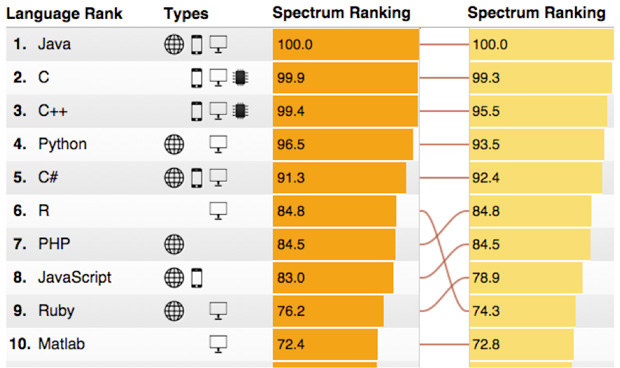
The Top 10 Languages according to IEEE Spectrum’s 2015 Rankings:

  1. Java
  2. C
  3. C++
  4. Python
  5. C#
  6. R
  7. PHP
  8. JavaScript
  9. Ruby
  10. Matlab

Note: HTML isn’t quite a “programming” language — it’s a markup language, meaning it’s a means of laying out the elements of a document. But it’s a “language” none the less, and one that pretty much every web developer taps endlessly, so we’ll let the semantic stuff slide

R — The Big Mover in IEEE Spectrum’s 2015 Rankings for Top 10 Programming Languages

The column on the left is the 2015 ranking; the column on the right is the 2014 ranking for comparison:

top-tech-rankings

source: The 2015 Top Ten Programming Languages

The thing to note is that the top 5 languages haven’t budged from their positions. R has pushed past PHP, JavaScirpt and Ruby, which have maintained their relative positions.  So this year’s rankings have been about R moving forward.

Object Oriented Programing with Python – Particle Diffusion Simulation

I’m a newbie to the programming world. I first started programming in Python in May this year, a month after I started this blog, so I still haven’t learnt enough to contribute to economics as is the stated goal of this blog. But I know I’ll get there in a year or less.

This blog was also meant to document my learning. In May, I would have called myself Newb v0.0. Today, 3 months later, I’d like to call myself Newb v0.3 and the goal is to be at least Expert v1.0 by January 2016.

With the help of Rice University’s awesome classes on Python programming I created a cool simulation of particles diffusing into space, using the concept of Classes, which I learnt just yesterday!

Click to check out the code !

Screenshot from 2015-07-23 11:49:00

Screenshot from 2015-07-23 11:49:10

Screenshot from 2015-07-23 11:49:39

Skillset Necessary for Data Science

I came across this truly amazing visualization of what it takes to foray into data science by @kzawadz via twitter MarketingDistillery.com

data science

Which Programming Language Should I Learn First? [Infographic]

Here’s a pretty interesting flow chart to determine which programming language would suit you:

Which Programming Language Should I Learn First? [Infographic].

or

Click here for the PDF

Number of Inversions in an Unsorted Array: Python Code

This is my solution to the first programming assignment of Tim Roughgarden’s course on Algorithms  that was due 12:30 PM IST today. Here’s the question quoted as it is:

Programming Question-1
Download the text file here. (Right click and save link as) This file contains all of the 100,000 integers between 1 and 100,000 (inclusive) in some order, with no integer repeated.

Your task is to compute the number of inversions in the file given, where the ith row of the file indicates the ith entry of an array.
Because of the large size of this array, you should implement the fast divide-and-conquer algorithm covered in the video lectures. The numeric answer for the given input file should be typed in the space below.
So if your answer is 1198233847, then just type 1198233847 in the space provided without any space / commas / any other punctuation marks. You can make up to 5 attempts, and we’ll use the best one for grading.
(We do not require you to submit your code, so feel free to use any programming language you want — just type the final numeric answer in the following space.)

My Solution

I modified an earlier code I wrote for merge sort to arrive at the solution. It needed just a couple of modifications, and if you look carefully, it turns out that the number of inversions are unearthed each and every time we merge two sorted sub-arrays. So, intuitively, if the merge sort algorithm was O(nlog2 n), it would take almost as many operations for counting inversions. In python, the code to sort and count inversions in an array of 10,000 integers took less than 3 seconds.

# load contents of text file into a list
# numList
NUMLIST_FILENAME = "IntegerArray.txt"
inFile = open(NUMLIST_FILENAME, 'r')
with inFile as f:
numList = [int(integers.strip()) for integers in f.readlines()]
count = 0
def inversionsCount(x):
global count
midsection = len(x) / 2
leftArray = x[:midsection]
rightArray = x[midsection:]
if len(x) > 1:
# Divid and conquer with recursive calls
# to left and right arrays similar to
# merge sort algorithm
inversionsCount(leftArray)
inversionsCount(rightArray)
# Merge sorted sub-arrays and keep
# count of split inversions
i, j = 0, 0
a = leftArray; b = rightArray
for k in range(len(a) + len(b) + 1):
if a[i] <= b[j]:
x[k] = a[i]
i += 1
if i == len(a) and j != len(b):
while j != len(b):
k +=1
x[k] = b[j]
j += 1
break
elif a[i] > b[j]:
x[k] = b[j]
count += (len(a) - i)
j += 1
if j == len(b) and i != len(a):
while i != len(a):
k+= 1
x[k] = a[i]
i += 1
break
return x
# call function and output number of inversions
inversionsCount(numList)
print count

Test my solution here with your own test cases.

Introducing cricketr! : An R package to analyze performances of cricketers

Wicked! Or must I say ‘howzzat!?’

Tinniam V Ganesh's avatar Giga thoughts ...

Yet all experience is an arch wherethro’
Gleams that untravell’d world whose margin fades
For ever and forever when I move.
How dull it is to pause, to make an end,
To rust unburnish’d, not to shine in use!

Ulysses by Alfred Tennyson

Introduction

This is an initial post in which I introduce a cricketing package ‘cricketr’ which I have created. This package was a natural culmination to my earlier posts on cricket and my completing 9 modules of Data Science Specialization, from John Hopkins University at Coursera. The thought of creating this package struck me some time back, and I have finally been able to bring this to fruition.

So here it is. My R package ‘cricketr!!!’

This package uses the statistics info available in ESPN Cricinfo Statsguru. The current version of this package only uses data from test cricket. I plan to develop functionality for One-day and…

View original post 4,951 more words

Statistics: The Sexiest Job of the Decade

Anyone who’s got a formal education in economics knows who Hal Varian is. He’s most popularly known for his book Intermediate Economics. He’s also the Chief Economist at Google. He is known to have famously stated more or less, that statisticians and data analysts would be the sexiest jobs of the next decade.

That has come true, to a great extent, and we’ll be seeing more.

Great places to learn more about data science and statistical learning:
1] Statistical Learning (Stanford)
2] The Analytics Edge (MIT)

In a paper called ‘Big Data: New Tricks for Econometrics‘, Varian goes on to say that:

In fact, my standard advice to graduate students these days is “go to the computer science department and take a class in machine learning.” There have been very fruitful collaborations between computer scientists and statisticians in the last decade or so, and I expect collaborations between computer scientists and econometricians will also be productive in the future.

See Also: Slides on Machine Learning and Econometrics

Algorithmic Game Theory Lecture Videos and Notes

Link to Stanford professor, Tim Roughgarden’s video lectures on algorithmic game theory (AGT):

2013 Iteration
http://theory.stanford.edu/~tim/f13/f13.html

2014 Iteration
http://theory.stanford.edu/~tim/f14/f14.html

I’m currently doing his Coursera MOOC on algorithms, divided into 2 parts:

https://www.coursera.org/course/algo
https://www.coursera.org/course/algo2

timroughgarden's avatarTuring's Invisible Hand

I’m teaching my algorithmic game theory course at Stanford this quarter, and this time around I’m posting lecture videos and notes.  The videos are a static shot of my blackboard lectures, not MOOC-style videos.

The course home page is here.  Week 1 videos and notes, covering several motivating examples and some mechanism design basics, are already available.  This week (Week 2) we’ll prove the correspondence between monotone and implementable allocation rules in single-parameter environments, and introduce algorithmic mechanism design via Knapsack auctions.

The ten-week course has roughly four weeks of lectures on mechanism design, three weeks on the inefficiency of equilibria (e.g., the price of anarchy), and three weeks on algorithms for and the complexity of learning and computing equilibria. Periodically, I’ll post updates on the course content in this space.  I would be very happy to receive comments, corrections, and criticisms on the course organization and content.

View original post