Karatsuba Multiplication Algorithm – Python Code

Motivation for this blog post

I’ve enrolled in Stanford Professor Tim Roughgarden’s Coursera MOOC on the design and analysis of algorithms, and while he covers the theory and intuition behind the algorithms in a surprising amount of detail, we’re left to implement them in a programming language of our choice.

And I’m ging to post Python code for all the algorithms covered during the course!

The Karatsuba Multiplication Algorithm

Karatsuba’s algorithm reduces the multiplication of two n-digit numbers to at most  n^{\log_23}\approx n^{1.585} single-digit multiplications in general (and exactly n^{\log_23} when n is a power of 2). Although the familiar grade school algorithm for multiplying numbers is how we work through multiplication in our day-to-day lives, it’s slower (\Theta(n^2)\,\!) in comparison, but only on a computer, of course!

Here’s how the grade school algorithm looks:
(The following slides have been taken from Tim Roughgarden’s notes. They serve as a good illustration. I hope he doesn’t mind my sharing them.)

gradeSchoolAlgorithm

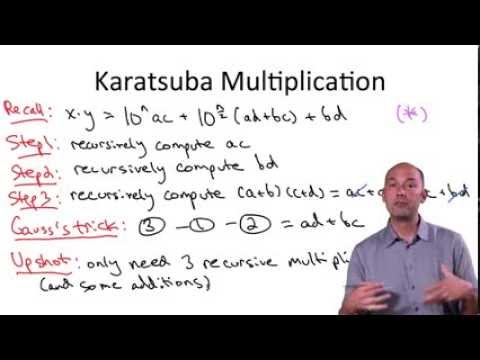
…and this is how Karatsuba Multiplication works on the same problem:

exampleKaratsuba

recursiveKaratsuba

A More General Treatment

Let x and y be represented as n-digit strings in some base B. For any positive integer m less than n, one can write the two given numbers as

x = x_1B^m + x_0
y = y_1B^m + y_0,

where x_0 and y_0 are less than B^m. The product is then

xy = (x_1B^m + x_0)(y_1B^m + y_0)
xy = z_2B^{2m} + z_1B^m + z_0

where

z_2 = x_1y_1
z_1 = x_1y_0 + x_0y_1
z_0 = x_0y_0

These formulae require four multiplications, and were known to Charles Babbage. Karatsuba observed that xy can be computed in only three multiplications, at the cost of a few extra additions. With z_0 and z_2 as before we can calculate

z_1 = (x_1 + x_0)(y_1 + y_0) - z_2 - z_0

which holds since

z_1 = x_1y_0 + x_0y_1
z_1 = (x_1 + x_0)(y_1 + y_0) - x_1y_1 - x_0y_0

A more efficient implementation of Karatsuba multiplication can be set as xy = (b^2 + b)x_1y_1 - b(x_1 - x_0)(y_1 - y_0) + (b + 1)x_0y_0, where b = B^m.

Example

To compute the product of 12345 and 6789, choose B = 10 and m = 3. Then we decompose the input operands using the resulting base (Bm = 1000), as:

12345 = 12 · 1000 + 345
6789 = 6 · 1000 + 789

Only three multiplications, which operate on smaller integers, are used to compute three partial results:

z2 = 12 × 6 = 72
z0 = 345 × 789 = 272205
z1 = (12 + 345) × (6 + 789) − z2z0 = 357 × 795 − 72 − 272205 = 283815 − 72 − 272205 = 11538

We get the result by just adding these three partial results, shifted accordingly (and then taking carries into account by decomposing these three inputs in base 1000 like for the input operands):

result = z2 · B2m + z1 · Bm + z0, i.e.
result = 72 · 10002 + 11538 · 1000 + 272205 = 83810205.

Pseudocode and Python code

procedure karatsuba(num1, num2)
if (num1 < 10) or (num2 < 10)
return num1*num2
/* calculates the size of the numbers */
m = max(size_base10(num1), size_base10(num2))
m2 = m/2
/* split the digit sequences about the middle */
high1, low1 = split_at(num1, m2)
high2, low2 = split_at(num2, m2)
/* 3 calls made to numbers approximately half the size */
z0 = karatsuba(low1,low2)
z1 = karatsuba((low1+high1),(low2+high2))
z2 = karatsuba(high1,high2)
return (z2*10^(2*m2))+((z1-z2-z0)*10^(m2))+(z0)

def karatsuba(x,y):
"""Function to multiply 2 numbers in a more efficient manner than the grade school algorithm"""
if len(str(x)) == 1 or len(str(y)) == 1:
return x*y
else:
n = max(len(str(x)),len(str(y)))
nby2 = n / 2
a = x / 10**(nby2)
b = x % 10**(nby2)
c = y / 10**(nby2)
d = y % 10**(nby2)
ac = karatsuba(a,c)
bd = karatsuba(b,d)
ad_plus_bc = karatsuba(a+b,c+d) – ac – bd
# this little trick, writing n as 2*nby2 takes care of both even and odd n
prod = ac * 10**(2*nby2) + (ad_plus_bc * 10**nby2) + bd
return prod
view raw karatsuba.py hosted with ❤ by GitHub

Comments

22 responses to “Karatsuba Multiplication Algorithm – Python Code”

  1. Murat Serdar Alperen Avatar
    Murat Serdar Alperen

    Hi, things like getting input as integers and using functions may be a trouble for beginners, so here is a “running off the shelf” version: https://repl.it/CBno

    Like

  2. Patrick Dennis Avatar
    Patrick Dennis

    Thank you so much for the “writing n as 2*nby2” tip. Without it, just using 10**n * (a * c), the algorithm works for all four-digit numbers (as far as I can tell), but fails on about one eight-digit problem out of eight, more with higher numbers of digits. I had found that the failures were related to getting an odd number of digits with a split, since leading zeros are dropped (45670123 splits as 4567 and 123), and had been trying to fix it by going to strings and padding out leading zeros. That actually reduced the failure rate, but fails still occurred. Your simple fix removed the whole issue!

    Like

  3. varenya Avatar
    varenya

    Hi,
    I found your implementation amusing because of the usage of / and % operators as they take more time than the actual problem
    Did you test your results for large size inputs?
    I believe those operators should be replaced by string concatenation for an efficient implementation

    Liked by 1 person

  4. bhaskarbalachander Avatar

    Hi, thanks for the 2*nby2 tip! However i’m a noob and still don’t understand how it works. Is it because python remembers that for odd numbers, the nby2 is actually a float and accounts for that when doing the multiplication?

    Thanks!

    Like

  5. Ten O'Clock Scholar Avatar
    Ten O’Clock Scholar

    Didn’t work for me! I copy-pasted verbatim and got RecursionError, maximum recursion depth exceeded with getting the str of an object.

    Like

    1. Obinna Okpolu Avatar

      Yes, that’s because wherever there is all division operator (‘/’) in the program, there should be an integer division operator (‘//’) instead.

      Like

  6. Gauri Shankar Badola Avatar
    Gauri Shankar Badola

    I wanted to read your whole code, but the starting of the code has the biggest flaw.

    if len(str(x)) == 1 or len(str(y)) == 1:
    return x*y

    what if x is 10, and y is 1 you still cant do 101.. you have to 1001 recursively.
    Unnecessary use of ** and %. Do you know ** works internally?

    Like

    1. Miguel Avatar
      Miguel

      “your program should restrict itself to multiplying only pairs of single-digit numbers.”

      with that IF statement you are failing to do so… lets say you multiply 7 x 213213321….(large number). Your code will do directly the multiplication without using the recursive method. (That multiplication will be done by whatever implementation python uses … perhaps its karatsuba too :D)

      What you can do is (lets say x has 1 digit and y has >1 digit):
      – check that we are in that case
      – you cannot split x, so you have to split y: 1 part with all digits but last one, and 2nd part with last digit
      – set a to 0 so you can use your f(a,b,c,d) katsuba formula when a is 0. if the 1 digit number is y, then c=0.
      – do this recursively until you arrive to 1digit by 1digit number multiplications

      Btw your code fails, has recursion errors. You shouldnt split numbers by half of the max(len(x),len(y)). what happens if x=123 and y=12345678… how do you split x into 4 digits?…you should use min instead of max. so you split x into [1,23] and y [123456,78] (or [12,3] and y [1234568,8]

      Like

  7. Kanu Patel Avatar
    Kanu Patel

    Thank you for the python code. This will help me multiply big numbers in short time.

    Like

  8. sakethv321 Avatar

    This is my first time visit here. From the tons of comments on your articles.I guess I am not only one having all the enjoyment right here! ExcelR Data Science Courses

    Like

  9. Anna Avatar

    I do not know why I got a wrong result when I have reproduced the code on my test case, it fails, anyone knows where the problem is?

    Like

    1. Obinna Okpolu Avatar
      Obinna Okpolu

      The problem is that wherever the program has a division operator (‘/’), it should be replaced with an integer division operator (‘//’).
      Otherwise, the program never reaches the base case since the length of the string conversion of the numbers do not become 1.

      Like

  10. video Avatar

    BBQ Grill/Fire Pit in 2001 Years, Our Factory Can Provide Cheap Price and Good Quality Product Around the World, Currently, Main Market is Germany/Poland/UK/US, Quality Inspection Standard is in Accordance with France/Germany. Our products look so cool and have hundreds of styles and sizes for you to choose. In this way, you can meet different requirements in different places. I believe there will be styles that you love!

    Like

  11. Donald Avatar
    Donald

    Thank you for the code. I was able to build this website using python.

    Like

  12. Asma Avatar
    Asma

    Hi waht should be the implementation of karatsuba for base 2 or any other base?

    Like

  13. George Iskander Avatar
    George Iskander

    The code need some modification to used // instead of /

    Like

  14. Bhavya Avatar

    Thank you for the great tips. also learn Data Science Course in Jersey City using python and r programming.

    Like

  15. iot course in bangalore Avatar

    I want to leave a little comment to support and wish you the best of luck .we wish you the best of luck in all your blogging endeavor’s.

    Like

Leave a comment



